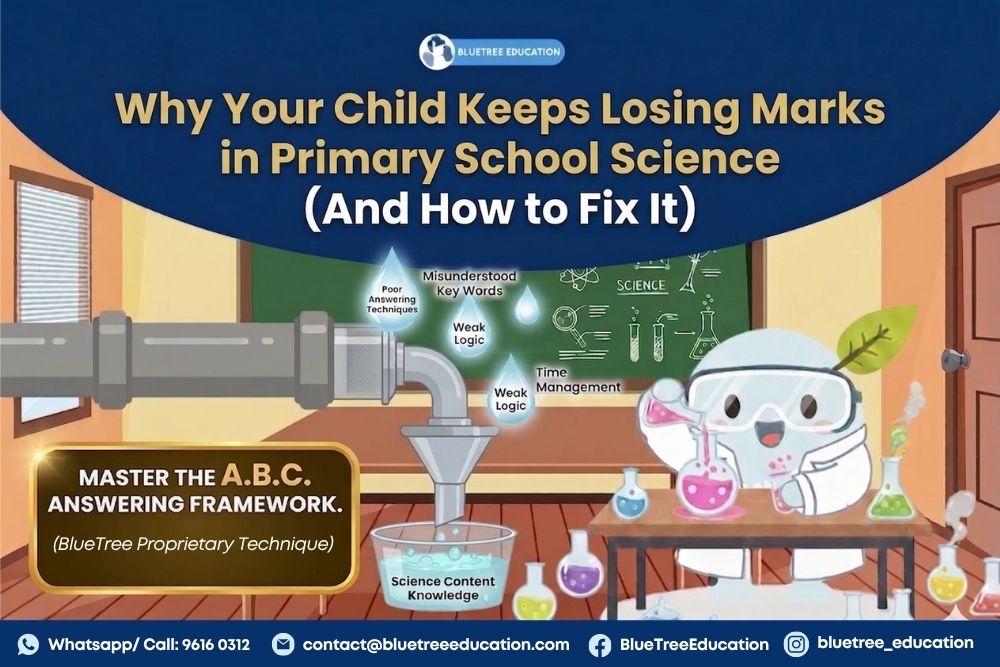
Your child finishes their science revision. You check their work. The concept seems right. But the marks still aren’t there.
This is one of the most common frustrations we hear from parents of primary school students in Singapore: “My child studies, but the results just don’t show.” “He knows the content — I don’t know where the marks are going.” “Every revision session ends in an argument.”
Here's the truth: knowing science content and knowing how to answer science exam questions are two completely different skills. Most students are only being trained in one of them.
In this article, we’ll break down why primary school science is harder to score than it looks, what the most common mistakes are, and how BlueTree’s structured proprietary answering techniques (A.B.C. and H.U.A.T.) help students write confident, mark-worthy answers — every time.
Table of Contents
Does Any of This Sound Familiar?
Before we talk solutions, let’s name the problem. Here are the patterns we see most often in students who are studying hard — but not scoring:
• They put in the hours, but not the right kind of practice — and grades stay flat
• They understand the concept but lose marks on how they write their answer
• They panic during exams — even falling sick before tests — because they don’t have a strategy
• They memorise content but it crumbles under pressure, because understanding was never built
• They can handle MCQ but freeze completely when faced with open-ended questions
• Every revision session turns into a fight — because frustration fills the gap where strategy should be
If any of these resonate, you’re not alone. And more importantly — every single one of these is fixable with the right approach.
Why Exam Stress Gets Worse Without a Strategy
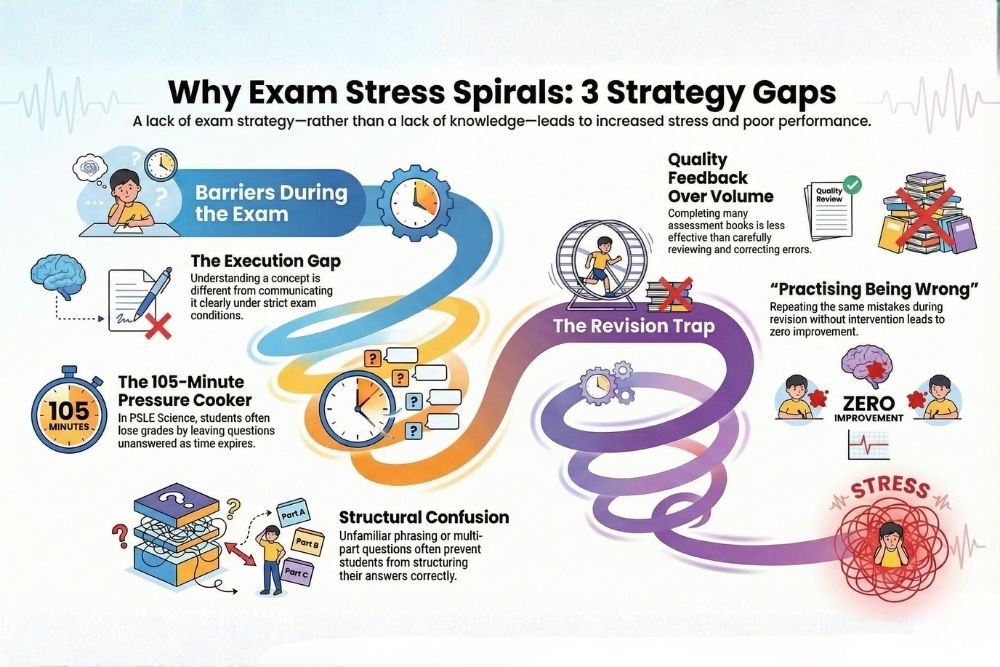
1. Confusion During the Exam
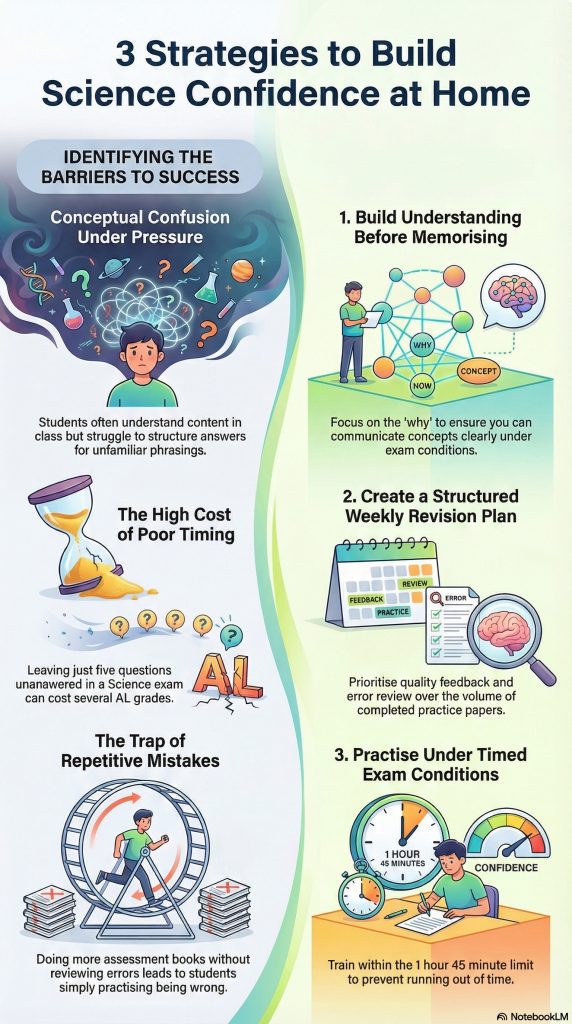
Students may understand the content in class — but when they face an unfamiliar question phrasing or a multi-part open-ended question, they don’t know how to structure their answer. Understanding a concept and being able to communicate it clearly under exam conditions are two very different things.
2. Poor Time Management Under Pressure
PSLE Science is 1 hour 45 minutes. We’ve seen students leave the last five or more questions unanswered — not because they didn’t know the content, but because they ran out of time. Those questions alone can cost several AL grades.
3. Repeating the Same Mistakes
When revision means doing more assessment books without reviewing errors, the same mistakes surface again and again. Students don’t improve — they just practise being wrong. Quality feedback matters far more than volume.
The 3 Things Your Child Needs to Score Well in Primary Science
To consistently score well in primary school science, three elements must work together. Remove any one of them and the results suffer.
1. Content Mastery
A deep understanding of the concepts — not just memorising — reinforced through hands-on experiments. When your child sees it, does it, and gets it, it sticks.
2. Proven Answering Technique they can always rely on
A proven structure they can always rely on — BlueTree’s A.B.C. & H.U.A.T. techniques, built to earn full marks on every PSLE OEQ and MCQ.
3. Self-Confidence
Built by having a reliable process — so students never walk into an exam feeling lost, unprepared, or like they’re guessing.”
Memorisation is fragile. Under pressure — anxiety, illness, nerves — recalled facts disappear. But true understanding of a concept allows a student to reconstruct their answer from first principles, even when anxious.
This is especially important as students move from P3 to P6. Concepts become more interconnected: a gap in P4 topics like magnets or states of matter creates confusion in P5 and P6 topics that build directly on them.
These three elements — content, strategy, and confidence — are deeply interlinked. You cannot build one without the others.
The BlueTree A.B.C. Technique: How to Answer Primary Science OEQs
Open-ended questions are where most primary school science marks are lost. Students either write too little, miss required keywords, or give answers that are technically correct but not structured the way the examiner marks.
Knowing the answer isn’t enough. PSLE Science OEQs reward structure — and punish students who answer without it. Every question has a formula: the right keywords, evidence to back it up, and the underlying concept confirmed. Most students skip steps without realising it. That’s where the marks disappear.
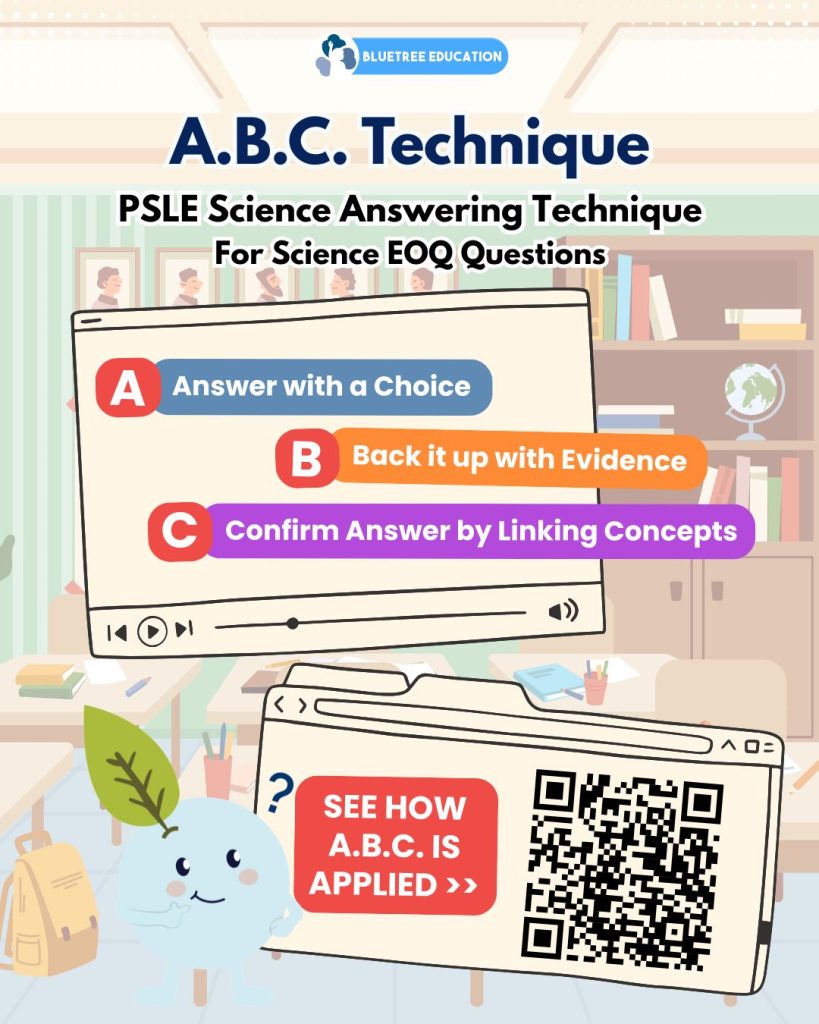
At BlueTree, we teach every student the A.B.C. Technique — a clear, three-step structure that ensures they hit every component of the mark scheme, every time:
-
Answer with a ChoiceStart by stating your answer directly — don’t bury it in explanation. For comparison questions, PSLE markers expects precise language: not just “the sound is softer” but “the sound produced is softer than [reference].” That comparison word is often the difference between full marks and zero.
-
Back with EvidenceSupport your answer with evidence from the question — data from a table, information from a diagram, or observations from the passage. This is where many students lose marks: they give a correct answer but provide nothing to support it. Evidence proves the student is engaging with the question, not just recalling memorised facts.
-
Confirm the ConceptLink back to the science concept being tested. This is the reasoning layer — the “why” behind the answer. It’s what elevates a partial-mark answer into a full-mark answer. PSLE examiners are assessing whether the student understands the concept, not whether they guessed a correct statement.
Question context: A question about sound produced in a given scenario.
A (Answer with a Choice): "The sound produced is softer than [the reference]."
B (Back with Evidence): "This is shown by the data in the diagram, where [specific reading] is lower than [comparison value]."
C (Confirm the Concept): "This is because [science concept] results in less energy being transferred, producing a softer sound."
Writing just "the sound is softer" with no evidence or reasoning scores zero marks — even if the answer direction is correct. The A.B.C. Technique ensures students never leave marks on the table.
The BlueTree H.U.A.T Method: How to Tackle Primary Science MCQs
Multiple choice questions might look straightforward — but students regularly lose marks by misreading questions, confusing similar concepts, or guessing without reasoning.
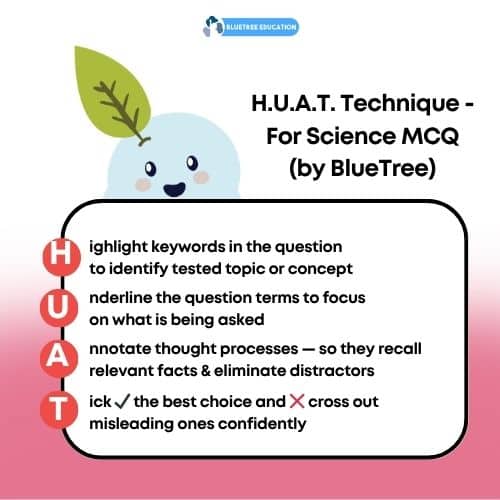
At BlueTree, we teach the H.U.A.T. method for MCQ. We never tell students “the answer is B.” We walk through every option and explain why each one is correct or incorrect — because we want students to understand the concept, not just to memorise the answers.
-
Highlight Keywords to Identify Topic or ConceptIdentify and underline the key terms in the question — especially words like ‘not’, ‘except’, ‘most likely’, and ‘which of the following’. These words change the entire direction of the answer.
-
Underline the Question TermsIdentify exactly what the question is asking for. Students often answer a different question to the one on the paper — this step prevents that.
-
Annotate the Thought ProcessesAdd notes around the question based on what you know about the science concept being tested. This activates recall before you evaluate the options.
-
Tick ✔️ the best choice and ❌ cross out misleading ones confidentlyEvaluate each option systematically — cross out options you can disprove using your science knowledge, not just intuition.
Question context: A question about sound produced in a given scenario.
A (Answer with a Choice): "The sound produced is softer than [the reference]."
B (Back with Evidence): "This is shown by the data in the diagram, where [specific reading] is lower than [comparison value]."
C (Confirm the Concept): "This is because [science concept] results in less energy being transferred, producing a softer sound."
3 Strategies to Build Science Confidence at Home
1. Build Understanding Before Memorising
Ask your child to explain a concept back to you in their own words — not recite it. If they can explain why plants need sunlight for photosynthesis (not just that they do), they understand it. If they can only recall the definition, they’re memorising. Memorisation fails when anxiety is high. Understanding doesn’t.
2. Create a Structured Weekly Revision Plan
Don’t let your child cram. Build a weekly plan together — 30 to 45 minutes of focused science revision, three times a week. Identify which topics are weak and prioritise those first. For P6 students, energy conversion and forces are among the most commonly tested and most commonly confused PSLE topics.
3. Practise Under Timed Exam Conditions
Get your child used to working under time pressure before exam day. PSLE Science is 1 hour 45 minutes — no notes, no help. Practise this at home. If they can’t finish on time, time management is the gap to close, not content.
When they complete a practice paper, don’t just mark it right or wrong — use it as a diagnostic tool. Ask: “Where did you lose marks? Was it the concept, the evidence, or the phrasing?” That question alone will improve the next attempt more than doing another paper.
Science Doesn't Have to Be a Struggle
The students who improve most in science aren't always the ones who study the longest. They're the ones who study with a strategy. When a child understands their concepts, knows how to structure an A.B.C. answer, can work through any MCQ with the H.U.A.T. method, and has practised under realistic exam conditions — they stop feeling lost. They start feeling prepared.
A prepared child is a confident child. And that confidence shows up in the exam hall — and in the results.