Is your child stuck at AL2 or AL3 in Science despite putting in hours of revision? How to help them score AL1 in PSLE Science?
The problem may not be what they know — but how they answer.
Here’s the truth: most Primary 6 students don’t lose marks because they don’t know the content. They lose marks because they don’t know how to answer Science questions in the way PSLE markers expect.
That’s why we teach proven techniques like our signature A.B.C. Technique™ and HUAT Techniques™, developed by ex-MOE teachers and PSLE markers. These methods have helped thousands of students move up to AL1, especially in Section B (Open-Ended Questions) — the section where most marks are lost.
In this article, you’ll discover exactly how to score AL1 in PSLE Science using answering techniques that work — even if your child already knows all the concepts but is still not scoring.
What we'll be sharing in this article [Hide]
🎯 What Does It Take to Score AL1 in PSLE Science?
The difference between AL2 and AL1 often comes down to answering technique.
Many students write what sounds right, but not what examiners are trained to mark.
Let’s compare these two answers:
❌ Weak Answer:
“The plant needs sunlight to grow.”
✅ Strong AL1 Answer:
“The plant needs sunlight for photosynthesis. Without sunlight, it cannot make food and will eventually die.”
The second answer includes:
- Accurate scientific keywords (“photosynthesis”, “make food”)
- Clear cause-and-effect explanation
- Direct relevance to the question context
This response shows conceptual understanding, and is the kind of response that earns full marks.
💡 Top Techniques for PSLE Students on Scoring AL1 in Science - The BlueTree Way!
1. 🧠 Use the A.B.C. Technique™ for Science OEQ (by BlueTree)
Here’s what the A.B.C. Technique is about:
- Answer the question with a choice
- Back it up with accurate, specific evidence from the question or concept
- Confirm the concept by linking it clearly to the Science idea being tested
Here’s an example of how A.B.C. is applied:
This 3-part structure ensures that answers are complete, logical, and keyword-rich, which are essential for scoring AL1.
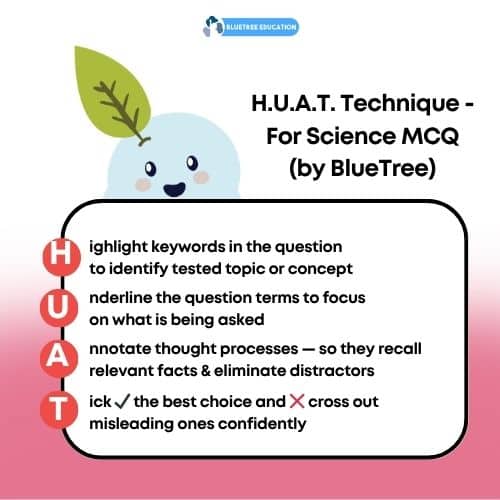
2. 🧨 Apply the HUAT Techniques™ for Science MCQ (Unique to BlueTree)
HUAT stands for a powerful set of answering tools for PSLE Science MCQs that help your child H.U.A.T. their way to full marks:
- Highlight keywords in the question to identify tested topic or concept
- Underline the question terms to focus on what is being asked
- Annotate thought processes — so they recall relevant facts & eliminate distractors
- Tick ✔️ the best choice and ❌ cross out misleading ones confidently
Example Question:
H.U.A.T. technique trains students to slow down, decode the question, and pick the best answer for MCQ questions with confidence.
3. 📘 Mastering PSLE Science Open-Ended Questions
Open-ended questions are where most students drop from AL1 to AL2 or lower.
To score full marks:
- Include scientific terms (e.g. “condensation”, “transfer of energy”, “heat flows from a hotter to a colder object”)
- Avoid vague words like “because it is hot” — be specific
- Write in complete, logical sentences showing conceptual understanding
❌ Weak Answer: “The metal spoon gets hot.”
✅ Strong Answer: “The metal spoon is a good conductor of heat, so heat from the hot soup is transferred quickly to the spoon.”
4. 🔍 Compare, Explain, Infer: Know the Common Question Types
Some questions test your child’s ability to compare results, infer causes, or explain processes. These require more than a one-line answer.
- Inference: “What can you conclude from this result?”
- Comparison: “Why does object A cool faster than B?”
- Explanation: “Explain why the balloon expands.”
Each type needs a different approach. BlueTree’s teachers will help your child learn exactly how to answer each one.
5. 📊 Analyse Model Answers and Marking Schemes
To learn how to score AL1 in PSLE Science, your child must study how PSLE markers award marks.
At BlueTree, we:
- Guide students on how MOE examiners award marks for the different answers
- Highlight why 1 vs 2 marks were awarded
- Let students practice marking their own work to develop “examiner eyes”
Read Also: Why Science Keywords Matter for PSLE — And How They Can Help Your Child Score Higher
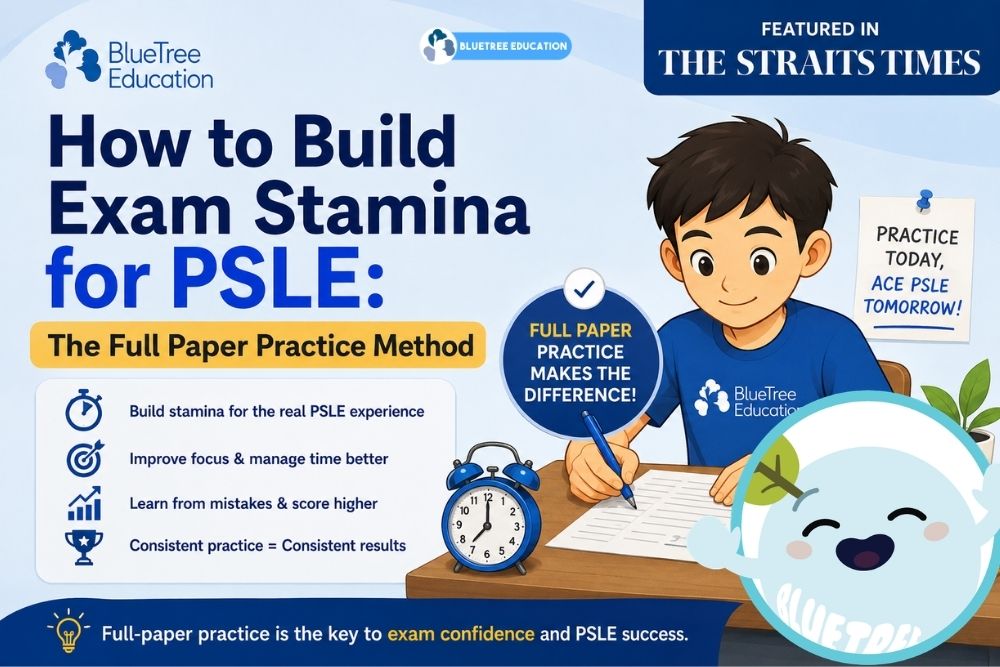
5. ✍️ Practice Like It’s the Real Exam to Build Stamina
No matter how strong your child is, they must learn to:
- Manage time under pressure
- Write clearly and concisely
- Answer within exam constraints
That’s why we run PSLE Science Mock Exams, Holiday classes focusing on Open-Ended Questions mastery and PSLE Masterclass — designed to equip students with crucial exam scoring techniques and give students a clear path to scoring higher.
🚀 Final Tips: Tips for PSLE Parents!
✅ Focus on Open-Ended answering accuracy
✅ Master key question types
✅ Use precise keywords & scientific terms
✅ Understand what PSLE markers look for
✅ Simulate real exam conditions often
🎓 Ready to Boost Your Child's Science Grades?
Choose the right programme to support your child’s PSLE journey:
🔍 Whether they need a strong head start or expert coaching on answering techniques, we’ve got you covered.
PSLE Science Trial Class
Strengthen Science fundamentals and score confidently with proven PSLE answering techniques, taught by trained teachers. Join On-Site or Online classes today.
PSLE Science Masterclass
Highly-targeted sessions to equip your child with answering techniques for the PSLE Science Paper (Live Coaching with ex-PSLE Markers) (Held via Zoom)