If your child freezes, avoids, or keeps losing marks in PSLE Math problem sums, you’re not alone. Many Primary students struggle with problem sums not because they are weak in Math — but because they lack the skills to analyse word problems, identify key clues, and apply the correct method under exam pressure.
From Primary 3 to Primary 6, problem sums become longer, trickier, and more reasoning-heavy. Without the right strategies, students quickly feel overwhelmed, anxious, or careless — especially in PSLE-style questions.
In this guide, we break down 5 telltale signs your child is struggling with PSLE Math problem sums, using real exam-style questions. More importantly, we’ll show you why students struggle and what needs to be fixed before these gaps snowball into major PSLE “mark stealers”.
Table of Contents
If your child freezes, avoids attempting problem sums, or loses marks despite “knowing how to do it,” you’re not imagining things.
Problem sums demand three skills at once:
👉 comprehension of language
👉 logical reasoning
👉 accurate application of concepts
When even one of these breaks down, the struggle snowballs — especially from P4 onwards, and even more so in PSLE-style questions where method marks, clarity, and stamina matter.
The good news?
Most problem sums struggles are predictable, diagnosable, and fixable — if you know what to look out for.
Sign 1: Avoidance or Anxiety When Facing Math Problem Sums
Why this matters: When students feel anxious, they often shut down before even identifying the concept tested. This leads to:
- careless errors,
- incomplete workings
- and lost method marks
even when the question is within their ability.
Exam-Style Question
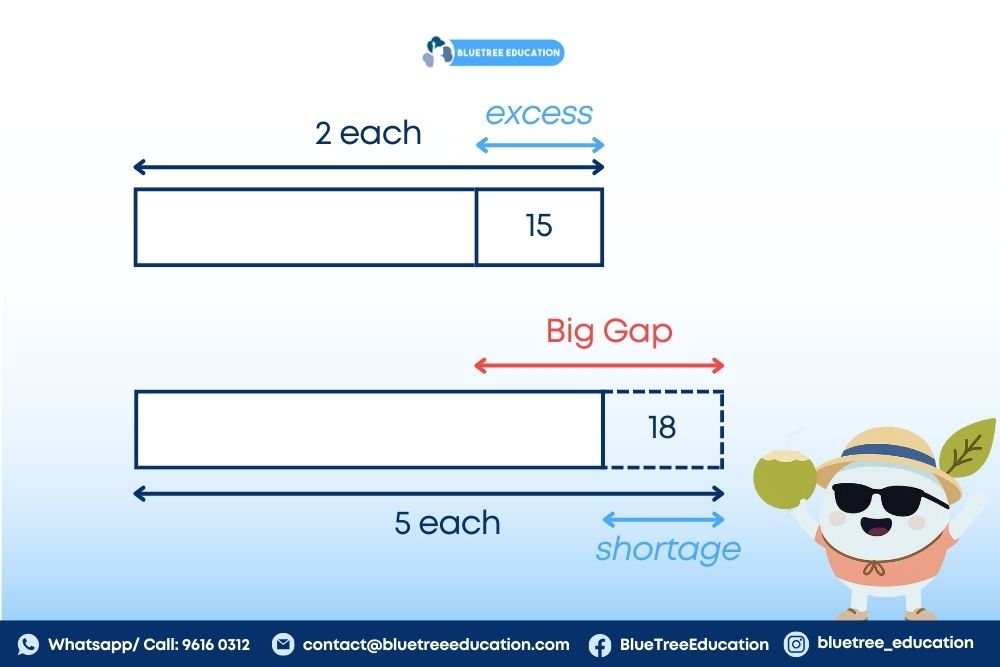
Mr Foo bought some stickers for his students for Children’s Day. If he gives each student 2 stickers, he will have 15 stickers left. If he gives each student 5 stickers, he will be short of 18 stickers. How many stickers did Mr Foo have?
Why Students Struggle With This Question
- Unable to identify the concept tested (excess & shortage)
- Unable to extract key information from a long question
- Unsure how to draw the models
- Confused about where to place “15 stickers left” and “short of 18 stickers”
- Anxiety causes students to rush without a plan
Question Breakdown using BlueTree’s T.C.M. Technique
- Topic: Whole Numbers
- Concept: Excess & Shortage
- Method: Big Gap & Small Gap, Model Drawing
How This Question Should Be Approached (Applying S.O.L.VE.)
S — Search for Clues
- Students should read, rewrite, and draw out information:
- “2 stickers each”
- “15 stickers left” → extra → inside model
- “short of 18 stickers” → need more → outside model
This step reduces anxiety by giving students control and clarity.
O — Obtain Evidence
- Big gap = 15 + 18 = 33
- Small gap = 5 − 2 = 3
- Number of students = 33 ÷ 3 = 11
L — Locate the Key
Not required (no unitary method needed)
VE — solVE the Mystery
Based on first model:
Stickers needed if each student receives 2 → 11 x 2 = 22
Total number of stickers → 22 + 15 = 37 (Ans)
Based on second model:
Stickers needed if each student receives 5 → 11 x 5 = 55
Total number of stickers → 55 – 18 = 37 (Ans)
Common Mistakes Students Make
- Do not know what “left” and “short of” means
- Do not know how to present the information for “shortage” and “excess”
- Drawing wrong models
- Memorise methods and applying to the wrong question
What This Sign Tells Teachers: The student lacks confidence in problem analysis, not ability.
What Needs to Be Fixed
- Understanding of questions and concepts
- Highlight keywords like “extra”, “left”, “shortage”
- Keep drawing models to deepen understanding of question and concepts
Model drawings can speed up thinking processes and increase accuracy in solution too!
Sign 2: Weak Comprehension of Math Problem Sums
Why this matters: Students may know fractions well but still fail because they misinterpret keywords like less, left, or confuse fractions of a whole with fixed quantities.
Exam-Style Question
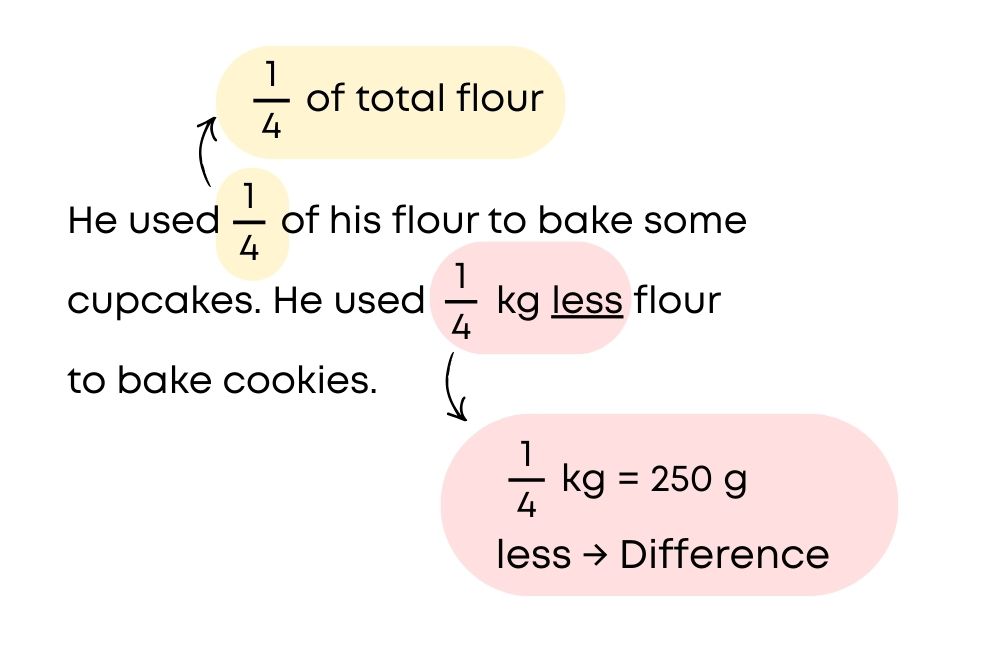
Bruce used 1/4 of his flour to bake cupcakes. He used 1/4 kg less flour to bake cookies. He was left with 2/3 of his flour. How much flour did Bruce have at first?
Why Students Struggle With This Question
- Misread 1/4 kg as 1/4 of total
- Misread 2/3 of flour as 2/3 of remainder or 2/3 kg
- Missed out key word like “1/4 kg less flour”
Making any of the above errors would have led to a wrong answer. the penalty would be 0 method marks and 0 answer mark.
- Topic: Fractions
- Concept: Remainder Fraction
- Method: Common Denominator & Unitary Method
How This Question Should Be Approached (Applying S.O.L.VE.)
S — Search for Clues
Read and write and draw out the information
By doing so, students are showing their understanding on the different terms and link them together.
Student may underline or highlight the keywords and annotate what does the keywords mean in the question.
Cupcake → 1/4 of total flour
Cookies → 1/4 of total flour – 1/4 kg → 1/4 of his flour – 250 g
(Change 1/4 kg to 250 g to avoid confusion with 1/4 of the total flour)
Both 1/4 of his flour and 2/3 of his flour refer to the amount of flour at first.
O — Obtain Evidence
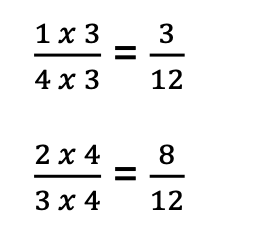
Total → 12 u
Left → 8 u
Cupcake → 3 u
Cookies → 3 u – 250 g
Cupcake + Cookies → 12 u – 8 u = 4 u
4 u → 3 u + 3 u – 250 g
2 u → 250 g
L — Locate the Key
Find 1 unit
1 u → 250 g ÷ 2 = 125 g
VE — solVE the Mystery
- Read the question again to confirm what the question is asking for
- Question is asking the mass of the flour at first
Common Mistakes Students Make
- Treating all “¼” as the same thing. Students assume: ¼ of flour = ¼ kg. This leads to completely wrong models and calculations.
- Ignoring “left with ⅔”. Many students calculate the used flour but forget that ⅔ of the total remains, which is a critical anchor for the entire solution.
- No unit consistency
Mixing fractions of a whole, kilograms & grams …without converting them properly.
- Skipping the model. Students jump straight into calculations without clarifying:
- What represents the total
- What portion is used
- What portion is remaining
What This Sign Tells Teachers: When a student struggles here, it’s not just a fractions issue.
It tells us that the student:
- Has not internalised that fractions can refer to the same whole in different ways
- Lacks a systematic approach to unpacking multi-layered information
- Is relying on guesswork instead of structure
- Needs guided practice in translating words → models → equations
- This is a comprehension gap, not a content gap.
What Needs to Be Fixed
- Fraction interpretation
- Keyword decoding
- Identify and highlight keywords like “less”, “kg”
- Interpret fractions accurately “2/3 of total” or “2/3 of remainder”
Sign 3: Doing for the Sake of Doing
Why this matters: Students refuse to draw models and rushing through solutions to get their tasks done for the day!
This is a classic Before-and-After internal transfer problem — one of the most misunderstood PSLE Math question types.
Exam-Style Question
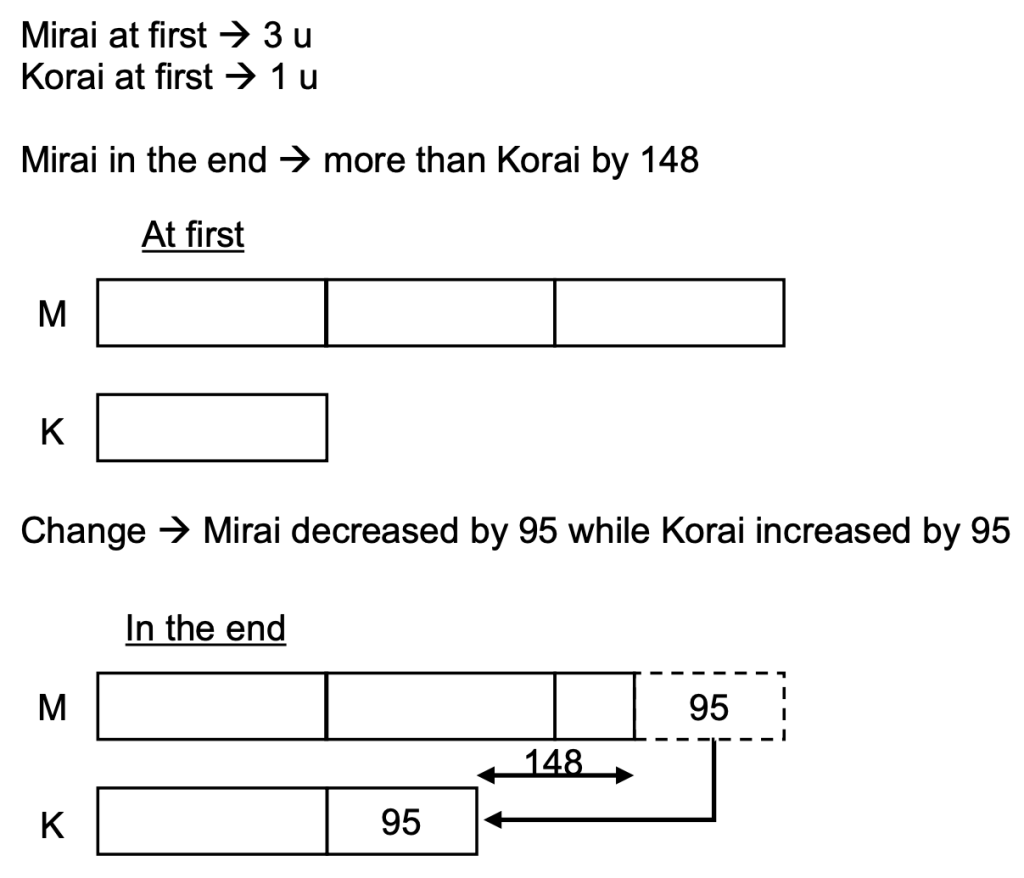
Mirai had thrice as many stamps as Korai. After Mirai gave 95 stamps to Korai, Korai had 148 less stamps than Mirai. How many stamps did Mirai have at first?
Why Students Struggle With This Question
- Unable visualise the model
- Unwilling to draw the model as the weightage of the question is small. This is usually a 2-mark question that can appear in either Paper 1 Section B or in Paper 2 as 1 of the first 5 questions.
- Dislike of drawing models. This results in students unable to notice that “95” is
repeated in the calculation of 2 units.
Question Breakdown using BlueTree’s T.C.M. Technique
- Topic: Whole Numbers
- Concept: Internal Transfer, Before and After
- Method: Model drawing, Unitary Method
How This Question Should Be Approached (Applying S.O.L.VE.)
S — Search for Clues
Read and write and draw out the information
By doing so, students are showing their understanding on the different terms and link them together.
Student may underline or highlight the keywords and annotate what does the keywords mean in the question.
O — Obtain Evidence
L — Locate the Key
Find 1 unit
1 u → 338 ÷ 2 = 169
VE — solVE the Mystery
- Read the question again to confirm what the question is asking for
- Question is asking the number of stickers Mirai had at first.
3 u → 169 x 3 = 507 (Ans)
Common Mistakes Students Make
Ignoring the transfer effect. Students subtract or add 95 once instead of recognising: Mirai loses 95 AND Korai gains 95
Solving based only on the final difference. They try to use 148 directly without accounting for the transfer.
Refusing to draw models. This causes students to miss how many “units” are actually changing.
What This Sign Tells Teachers:
- The student lacks conceptual discipline
- They are relying on pattern recognition, not reasoning
- They have not internalised before-and-after structures
- They lose marks not because the math is hard — but because the thinking is shallow
What Needs to Be Fixed
- Intentional Thinking Before Solving. Students must learn to pause and ask:
- What is changing?
- What stays the same?
- Is this before-and-after, internal transfer, or comparison?
Purposeful Steps (Not Blind Procedures). Every step should answer: “Why am I doing this?”
Sign 4: Careless or Incomplete Working
Why this matters: This is a hidden reason why marks are often lost in PSLE Math. Marks are awarded for method, clarity, and logical working — especially in higher-weight problem sums.
Exam-Style Question
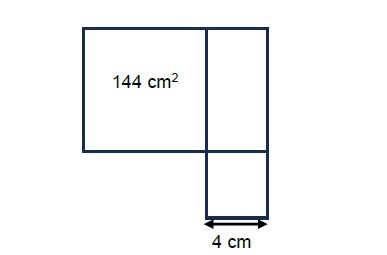
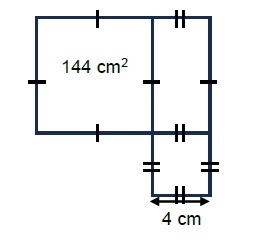
The figure is made up of 2 different squares and 1 rectangle.
What is the area of the figure?
Why Students Struggle With This Question
- Unable to differentiate length and area
- Adding numbers with different units of measurement
- Unable to recall square numbers
- Unable to identify which lines are repeated in the figure.
- Length of rectangle = Length of big square
- Students can highlight, add a dash or circle the line(s) to get their attention..
How This Question Should Be Approached (Applying S.O.L.VE.)
S — Search for Clues
Read and write and draw out the information
Annotate on the diagram for any similar lengths or angles
Length of rectangle = length of big square
Breadth of rectangle = length of small square
O — Obtain Evidence
Length of big square → 12 cm
Area of rectangle → 12 cm x 4 cm = 48 cm2
Area of small square → 4 cm x 4 cm = 16 cm2
L — Locate the Key
Not needed for this question as it does not use unitary method.
VE — solVE the Mystery
- Read the question again to confirm what the question is asking for
- Question is asking for area of the entire figure
- By reading and identifying what the question is asking for, the student will also recall the correct unit of measurement to put in their final answer.
Total area → 144 cm2 + 48 cm2 + 16 cm2 = 208 cm2 (Ans)
Common Mistakes Students Make
Recall: BlueTree’s NTUC Checking Method
Number → Student has identified the method of solving the question but used the wrong number from the question.
Transfer → Student copied or miswrite the number from one step to another.
Eg. 142 is written as 124 in the next step
0 is not written properly and it looked like a 6. Student unfortunately continued the working thinking the digit is 6.
Units → Student either forgot or wrote the wrong unit of measurement in their final answer. This can be mitigated by reading the question again to confirm what the question wanted the student to find.
Calculation → Student write the correct working but made a calculation error or entered the wrong number into the calculator.
What This Sign Tells Teachers:
When a student shows careless or incomplete working, it tells us that the issue is not a lack of ability, but a gap in process and discipline.
Specifically, it signals that the student:
Is not trained to slow down and analyse multi-step questions
Relies on intuition or guessing instead of structured methods
Has not developed the habit of annotating diagrams and organising information
Struggles to visualise relationships between shapes, lengths, and areas
What needs to be fixed?
Students must be trained to:
✔ Show clear, complete working to secure method marks
✔ Annotate diagrams to spot repeated or equal lengths
✔ Distinguish instantly between length (cm) and area (cm²)
✔ Apply a structured method like S.O.L.V.E. to organise information
✔ Slow down without losing confidence
Sign 5: Lack of Exam Stamina
Why this matters: Without proper training, students lose marks at the end of the paper. Not because they don’t know how to solve the questions, but simply because they are mentally exhausted.
Exam-Style Question
There are 50 questions in a test. For every correct answer, 5 marks will be awarded.
For every wrong answer, 3 marks will be deducted.
For every blank question, 1 mark will be deducted.
Caleb took the test and scored 122 marks. He left 4 questions blank.
How many questions did Caleb answer correctly?
Why Students Struggle With This Question
- This is a 4-mark question in Paper 2. Hence, it will appear in the latter half of the paper. Usually, students will start to feel the mental exhaustion if they are not used to the exam setting.
- Unable to identify the concept tested in this question.
- Does not know how to apply “4 questions blank” into their workings
- Unfamiliar with the phrasing of this question
- Students have seen assumption questions before. However, the usual assumption questions have only 2 types of options, whereas this question has 3 different options (Correct, wrong and blank)
Question Breakdown using BlueTree’s T.C.M. Technique
- Topic: Whole Numbers
- Concept: Assumption (Double Penalty)
- Method: Big Gap and Small Gap
How This Question Should Be Approached (Applying S.O.L.VE.)
S — Search for Clues
Read and draw out the information
- 1 correct answer → +5
1 wrong answer → -3
1 blank answer → -1
Final marks with 4 blank answers → 122
O — Obtain Evidence
- Loop and Link information together
- To apply the concept of Assumption, we need to remove one of the three question types. Thankfully, we know how many questions were left blank.
Questions attempted → 50 – 4 = 46
Marks lost to blank answers → 4 x 1 = 4
Actual marks scored → 122 + 4 = 126
Assume all 46 attempted questions are correct.
Recall: T – B – S – Oppo
Total → 46 x 5 = 230
Big gap → 230 – 126 = 104
Small gap → 5 + 3 = 8
Opposite (Wrong answers) → 104 ÷ 8 = 13
L — Locate the Key
Not needed for this question as it does not use unitary method.
VE — solVE the Mystery
- Read the question again to confirm what the question is asking for
- Question is asking for correct answers while we have found the number of wrong answers
Number of correct answers → 46 – 13 = 33 (Ans)
Common Mistakes Students Make
❌ Failing to identify the question type
Students do not recognise this as an assumption (double penalty) question, leading to random or incorrect methods.
❌ Ignoring or misusing key conditions. The detail “4 questions left blank” is either: forgotten, not factored into the calculation or incorrectly treated as wrong answers.
❌ Confusion caused by unfamiliar phrasing. Students are used to assumption questions with only: correct vs wrong.
This question introduces a third option (blank), which throws them off when tired.
❌ Incomplete or abandoned workings. Mental fatigue causes students to stop halfway, make careless arithmetic errors or rush through without checking.
These mistakes often happen towards the end of the paper, when focus is lowest.
What This Sign Tells Teachers:
When a student struggles with this type of question, it signals that:
- The student has not been sufficiently trained in exam stamina
- They may understand concepts individually but cannot apply them consistently under pressure
- Their problem-solving framework breaks down when tired
- They rely too heavily on memory instead of structured methods
In short, the student is not exam-ready yet, even if they have a strong mastery of concepts.
What Needs to Be Fixed
To overcome this, students need more than practice papers.
They need to be trained to:
✔ Recognise question types quickly, even when mentally tired
✔ Apply a fixed structure (e.g. assumption method, gap method) without guessing
✔ Extract and use every condition correctly (e.g. correct, wrong, blank)
✔ Build stamina through timed, exam-style practice
✔ Stay calm and systematic till the last question
In our Math Trial Class, your child will:
✅Build strong conceptual understanding based on the 2026 PSLE Math Changes
✅Learn how to analyse MCQs and answer open-ended questions confidently
✅Strengthen reasoning, explanation, and application skills
✅Receive personalised guidance from experienced PSLE Math specialists
Read Also: