If you’ve watched your child struggle through stacks of PSLE Science notes, only to forget key concepts days later, you’re not alone. Many students spend hours revising, yet find it difficult to retain and apply what they’ve learned when faced with exam questions. This is a common challenge in primary school Science, where the syllabus covers a wide range of interconnected topics.
Traditional study methods such as rote memorisation may help students recognise information temporarily, but they rarely lead to deep understanding or long-term retention. As a result, children often know their concepts — but struggle to explain concepts, make connections, or tackle PSLE Science OEQ questions.
This is where visual learning techniques like mind maps and flashcards make a powerful difference. Instead of treating each concept as an isolated fact to memorise, these methods help students organise information meaningfully, strengthen conceptual understanding, and build lasting connections across topics, ultimately leading to stronger exam performance.
So, let’s explore how these proven techniques can transform your child’s approach to studying.
What we'll be sharing in this article [Hide]
Why Visual Learning Works
The human brain is remarkably efficient at processing visual information, meaning that visual tools can transform complex concepts about life cycles, energy, and forces into digestible, memorable information.
Beyond simple memorisation, visual learning helps students see the bigger picture. Rather than treating each topic as an isolated fact to memorise, children can use visual aids to connect different concepts. This can help them understand, for instance, how the water cycle relates to plant systems, or how energy conversion appears across multiple themes. This is crucial for answering the application-based questions that characterise modern PSLE Science examinations.
Creating these visual tools is also an active process. Unlike passively reading through notes, students must engage deeply with the material, sorting information and identifying relationships. This active engagement significantly improves both comprehension and retention, essential elements for PSLE preparation.
Mastering PSLE Science with Mind Maps
Mind maps are one tool that can help students see how different topics connect and relate to one another. These are diagrams that visually organise information, clearly showing how different concepts relate to one another. They’re particularly effective because they mirror the way our brains naturally process and store information.
Creating a mind map is straightforward. Start with the central topic in the middle of the page, say, “Plant Reproduction.” From there, draw branches for the main subtopics such as “Parts of a Flower,” “Pollination,” and “Seed Dispersal.” Add smaller branches with key details, keywords, and simple drawings that illustrate the concepts.
For PSLE preparation, mind maps offer distinct advantages. They provide holistic revision, condensing an entire topic onto one page, making them ideal for quick review sessions before exams. They’re also invaluable for answering application questions as they can help students rapidly recall the interconnected concepts needed to tackle complex, multi-step problems.
Leveraging Flashcards for Targeted Revision
Whilst mind maps excel at showing relationships between concepts, flashcards are unmatched for focused, efficient practice. These simple tools are a cornerstone of effective PSLE preparation, particularly for mastering the precise scientific vocabulary that examiners look for.
Creating effective flashcards requires a clear structure. Write a single question or keyword on one side, for example, “What is photosynthesis?”, and the complete, detailed answer on the back, including all relevant keywords and explanations.
This is a particularly powerful tool when learning how to score well in Science exams, as they facilitate active recall, forcing the brain to retrieve information rather than simply recognising it. They’re also incredibly efficient, allowing students to test themselves on multiple Science topics in a short amount of time, quickly identifying areas that need further attention.
How BlueTree Education Reinforces Visual Learning
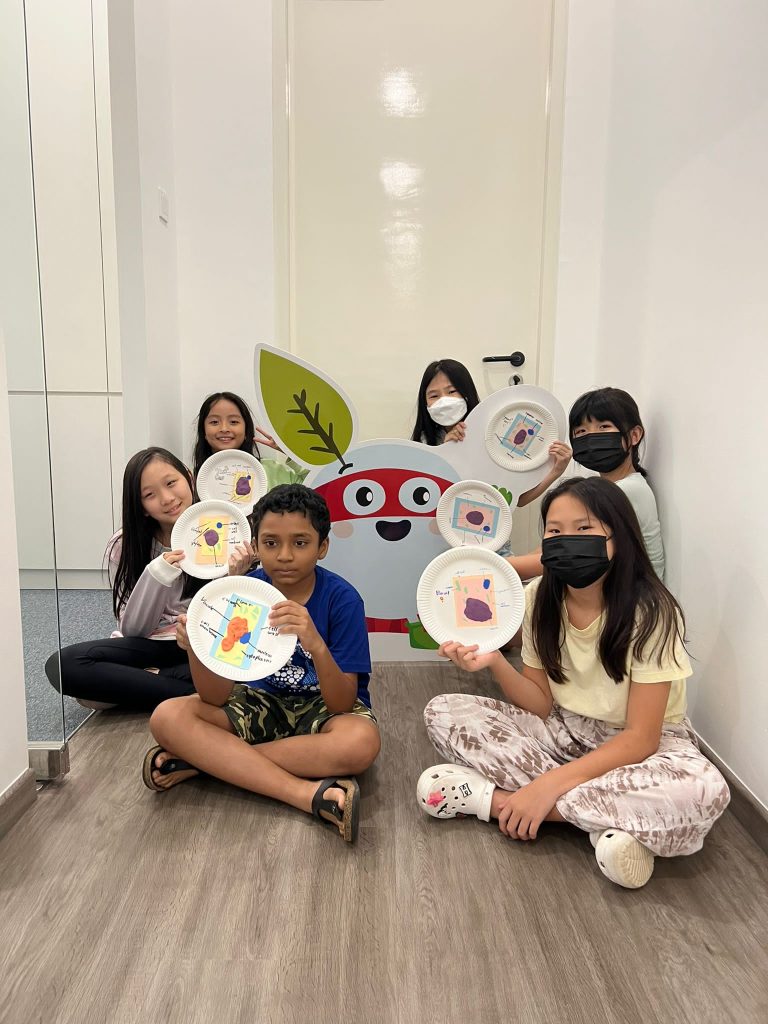
These visual learning techniques align perfectly with BlueTree’s teaching philosophy. Our passionate teachers don’t just deliver content—we guide students in building these conceptual connections from the very start of their primary school Science journey. Our in-house curriculum and structured practice sessions ensure that students learn not only the material but also effective strategies for organising and retaining that knowledge.
Combined with our proven exam strategies and answering techniques, this approach creates a comprehensive approach to PSLE preparation. This holistic method addresses both the “what” and the “how” of studying, unlocking each child’s full potential.
Transform Your Child's Study Habits
Incorporating visual tools like mind maps and flashcards can fundamentally change how your child approaches studying, making revision more effective, engaging, and ultimately more successful. These techniques complement the rigorous Science syllabus whilst making learning genuinely enjoyable.
Ready to see the difference? Try these techniques at home, and discover how BlueTree Education’s PSLE Science tuition and PSLE preparation programme can further enhance your child’s learning journey. Together, we can build the strong foundation your child needs for exam success and beyond.