Does Your Primary Child Struggle with Problem Sums?
If you’ve ever watched your child stare blankly at Math problem sums, get frustrated before they’ve even read the question, or rush through their homework just to “get it done”, you’re not alone. Many parents wonder whether what they’re seeing is normal, or whether it points to a deeper issue.
The truth is, children struggling with problem sums often show signs that are easy to miss, especially for busy parents.
Why Are Problem Sums So Hard?
Help with problem sums is one of the most searched topics among primary school parents in Singapore — and for a reason.
Problem sums are a core part of the Singapore Primary School Maths syllabus. Unlike straightforward calculation questions, problem sums require children to read, interpret, and apply mathematical concepts to real-world scenarios. They test not just computation skills, but also reading comprehension, logical reasoning, and time management.
The good news is that many of the warning signs are visible long before exam season. You just need to know what to look for.
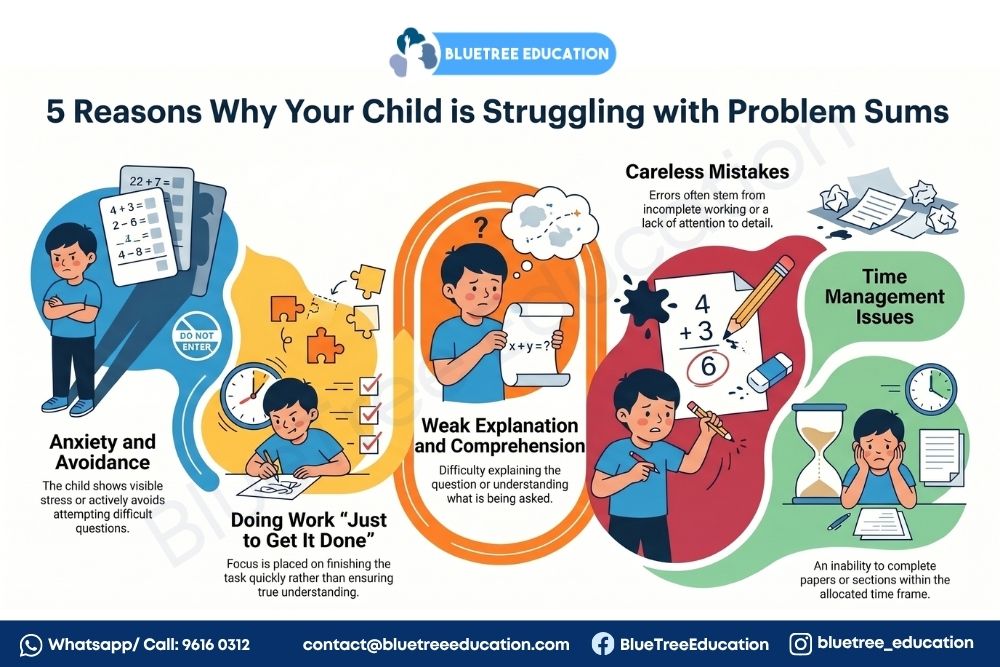
Here is a simple 5-point checklist that experienced primary school maths teachers use to identify whether a child is struggling, and what you can do about it.
Table of Contents
The 5-Point Checklist: Signs Your Child Needs Help With Problem Sums
Sign #1: Anxiety and Avoidance When Facing Difficult Questions
One of the most common — and most concerning — signs of a child struggling with problem sums is maths anxiety. This goes beyond simply disliking a subject. It can show up in ways that parents and teachers might mistake for bad behaviour or lack of effort.
What to look out for:
- Freezing up when they see a tricky question
- Getting agitated, throwing tantrums, or breaking down when they can’t solve a problem
- Suddenly needing to use the toilet right before answering questions in class
- Doodling excessively or walking around instead of attempting the work
- Raising their voice out of nowhere or becoming disruptive
What helps:
Start small. Build confidence by giving the child simpler questions first, then gradually increase difficulty — a technique known as scaffolding.
Always acknowledge every bit of progress, no matter how small. Positive reinforcement ("You did better than last week!") builds the emotional resilience children need to face harder problems.
Sign #2: Weak Explanation and Poor Comprehension of Questions
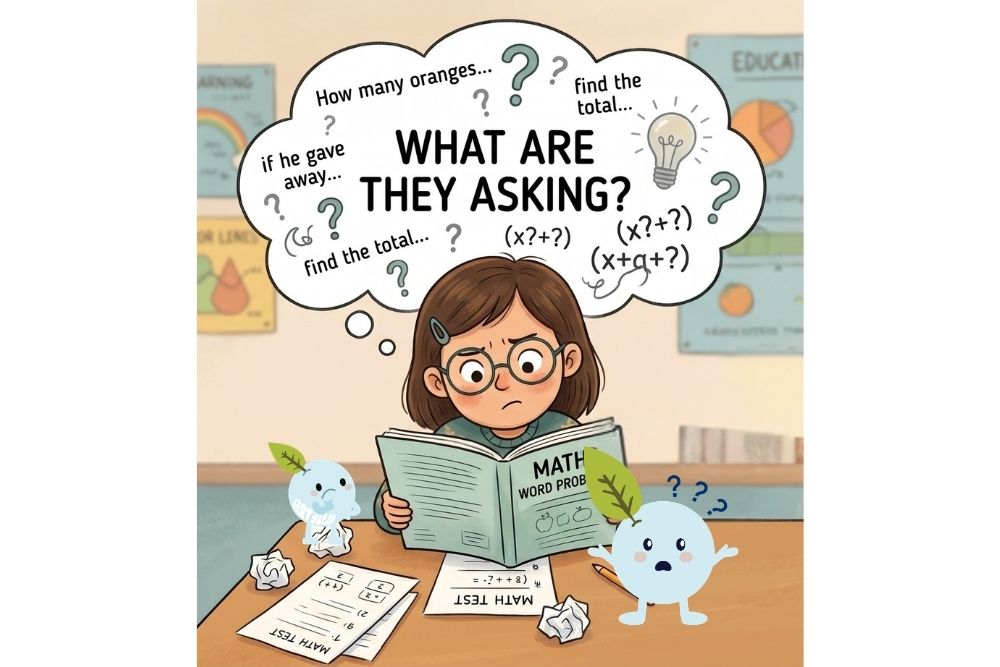
Some children can calculate perfectly well — but they can’t tell you what the question is asking. This is one of the most overlooked signs of struggling with problem sums, because their computation skills can mask the comprehension gap.
What to look out for:
- The child solves the calculation but answers the wrong question
- e.g., they find the total number of pens when the question asks how many pens someone has
- They can’t explain their working or thinking process in words
- They read the question multiple times without making progress
What helps:
The S.O.L.VE. technique — going sentence by sentence, identifying clues, and annotating key information — makes a significant difference.
Techniques like reading and writing approaches, where children are taught to search for clues within the question, help them slow down and truly understand what's being asked before they attempt to solve it.
Teaching children that encountering unfamiliar questions is part of the learning process (not a sign of failure) is equally important. Critical thinking skills must be developed alongside mathematical ones.
Sign #3: Doing Work “Just to Get It Done”
This one is surprisingly common, and it affects children across all ability levels. The child rushes through homework in the 30 minutes before the lesson, writes down anything that looks like an answer, and hands it in — not to demonstrate understanding, but simply to avoid getting into trouble.
What to look out for:
- Homework is completed suspiciously quickly
- Answers are haphazard or show no clear working
- The child can’t explain their answers when asked
- Work quality is noticeably worse than in-class performance
This sign is often less about laziness and more about an overloaded schedule. Many primary school children juggle CCA, tuition, enrichment lessons and sports, leaving little time or mental energy for genuine, focused practice.
When a child doesn’t have enough time to engage meaningfully with maths homework, they default to getting it done rather than getting it right.
What helps:
Look at the child's weekly schedule. If every spare hour is accounted for, something needs to give. Have a direct conversation with the child — and with teachers if needed — to understand whether the issue is a time constraint or a concept gap is the right first step.
From there, create a realistic study schedule that protects time for proper practice.
Sign #4: Careless Mistakes and Incomplete Working
Careless errors are one of the most frustrating issues in primary school maths for both children and parents. It feels like they know the material, so why do they keep losing marks?
What to look out for:
- Getting the right method but writing the wrong answer (e.g., a unit error or misreading a value)
- Answering a different part of the question than what was asked
- Skipping steps in their working
- Running out of steam toward the end of the paper and leaving final steps incomplete
In most cases, careless mistakes are not because the child is rushing for fun. Children often speed through what they find easy because they know, instinctively, that harder questions are coming and they need time for those. The problem is that without proper pacing, errors creep in (missing units, skipped steps, misread questions).
What helps:
Teach children to underline keywords in the question. Words like "altogether," "how much more," and "difference," and anchors their attention on what's actually being asked.
Encourage them to allocate their exam time strategically: move through easier questions quickly, but leave 10 minutes at the end for checking. Knowing what marks are awarded for (equations, units, correct labelling) helps children check efficiently rather than re-reading everything.
Sign #5: Unable to Finish the Paper in Time
The final sign is consistently running out of time. If you flip through your child’s exam papers and see a cluster of unanswered questions at the end, it’s worth taking seriously.
In the current PSLE Maths format, Paper 1 includes 30 questions to be completed in 1 hour 10 minutes, while Paper 2 has 15 questions in 1 hour 20 minutes. That’s not a lot of time, especially for children who haven’t built up exam stamina.
What to look out for:
- Consistently incomplete papers during practice
- Strong performance on short tasks but declining accuracy as the paper goes on
- The child doesn’t know which questions to prioritise
- No familiarity with their own pacing under timed conditions
What helps:
Exam stamina is like physical fitness: it has to be trained. Timed practices at home are essential, not just in school. Children should simulate real exam conditions: no interruptions, full paper, time tracked.
Over time, this builds the mental endurance to stay focused for the full duration. Beyond stamina, teaching children heuristic strategies — systematic shortcuts for solving common problem types — reduces the number of steps needed and saves precious time.
Every child is different. Some work front-to-back; others start with questions they’re confident about to build momentum. Helping your child discover their optimal approach is part of the process.
Some even write down all units before starting — because they know that’s where they lose marks. That kind of self-awareness is a skill worth developing.
When to Seek Extra Help With Problem Sums
If your child is showing two or more of these signs consistently, it’s worth getting targeted support sooner rather than later — especially if you’re heading into Primary 5 or 6. Early intervention is always easier than last-minute catch-up.
Look for programmes that:
- Teach heuristic methods (model drawing, guess-and-check, working backwards, etc.) so your child has the right tools for different question types
- Use a structured read-and-analyse approach to problem sums
- Include timed mock test practice to build exam stamina
- Address the thinking process, not just the answer
All of which BlueTree address!
Final Note
Noticing these signs early is not about alarming yourself or your child — it’s about giving them the chance to get the right support before small struggles become bigger ones. Just like any health concern, the earlier you spot it, the more manageable it is.
If you recognise one or more of these signs in your child, start a conversation. Talk to their teacher. Observe their working habits at home. And remember: struggling with problem sums doesn’t mean a child isn’t capable, it often just means they need the right strategies and the right support to get there.
Watch the Full Discussion Here
Ready to Give Your Child the Support They Need?
If you recognised any of these signs, the best first step is simply to find out where your child stands, without any pressure.
At BlueTree, our teachers are trained to spot exactly these struggles and meet every child where they are. Whether your child is dealing with maths anxiety, running out of time, or just needs a confidence boost, we’d love to help.
Book a trial class today and let’s take that first step together. 💙