PSLE Science Exam Format: How to Prepare Smart and Score AL1 in 2026

psle-science-exam-format

Is your child taking the PSLE Science exam soon? Understanding the PSLE Science exam format is the first step to score AL1 with confidence.

This guide explains the exam structure, key answering strategies, and how parents can support their child in mastering Science the smart way.

What we'll be sharing in this article [Hide]

🔍 What Is the PSLE Science Exam Format?

The PSLE Science paper is designed to assess not just factual recall but your child’s ability to apply key Science concepts. It is based on five core themes (MOE-Compliant):

  1. Diversity
  2. Cycles
  3. Systems
  4. Interactions
  5. Energy

PSLE Science Exam Structure

psle-science-exam-structure

How to Score AL1 in PSLE Science

To achieve an AL1, your child needs a raw score of 90 or above. Here’s how you can assist them to get there:

1. Master ALL Topics Content

Ensure your child understands every topic in the MOE Science syllabus. Skipping concepts can result in missed marks, especially in Science Open-Ended Questions (OEQs).

2. Use the Right Keywords in Answers

PSLE markers look for specific Science keywords or phrases in Open-Ended answers. Science answers must be precise. Writing long answers does not guarantee of getting any marks at all. Without these, even a correct idea might get zero marks.

For example: What is boiling?
❌ “Boiling is when water gets hot and turns into steam.”
✅ “Boiling is the process where a liquid gains heat to turn into gas at a fixed boiling point.”

Definition questions like this are becoming increasingly common in PSLE Science.

3. Apply BlueTre's Proven Exam Techniques

🌟 For Science MCQs: Use the HUAT Method (Bluetree Signature)

  • Highlight keywords to identify the tested topic.
  • Underline question terms (e.g. “why”, “how”).
  • Annotate your thought process.
  • Tick & Cross options to narrow down the best choice.

This method has been proven effective in helping students secure maximum marks and a step closer to achieving AL1.

Next, many parents are concerned with Open-Ended Questions which their child does not score well in this Section. At Bluetree, we use our signature ABC answering technique to break down much dreaded Science Open-Ended Questions into bite-sized parts, making them easier to tackle with confidence.

🌟 For Science OEQs: Use the A.B.C. Method (Bluetree Signature)

  • Answer with a choice.

  • Back up with scientific evidence.

  • Confirm using key concepts and correct terms.

Students who use A.B.C. gain clarity and structure in their exam responses, increasing their chances of scoring full marks.

Next, encourage your child to analyse and annotate Science Open-Ended Questions before answering. Annotation helps break down the question into manageable parts, ensuring that no detail is missed. It also trains your child to focus on what the question is truly asking, rather than recalling unrelated information.

This process not only improves the structure and clarity of their answers but also increases the chances of including all the necessary points. When students take the time to think through and annotate the question first, they often feel more in control and confident— resulting in clearer, more precise answers that are more likely to meet exam expectations.

4. Draw and Label Diagrams

A well-drawn diagram with proper labels can earn crucial marks. Without labels, diagrams lose meaning and may not be awarded marks.

5. Practise with Past Year PSLE & Prelim Papers to understand the PSLE Science Exam Format

Practising with top school prelim papers and PSLE past year papers helps your child:

  • Recognise common question types
  • Improve exam timing
  • Build confidence

Tip: Always go through mistakes together to improve understanding, not just correct answers.

Discover about PSLE/ Exam Intensive Course, where we go through Past-Year Prelim Papers in Detail!

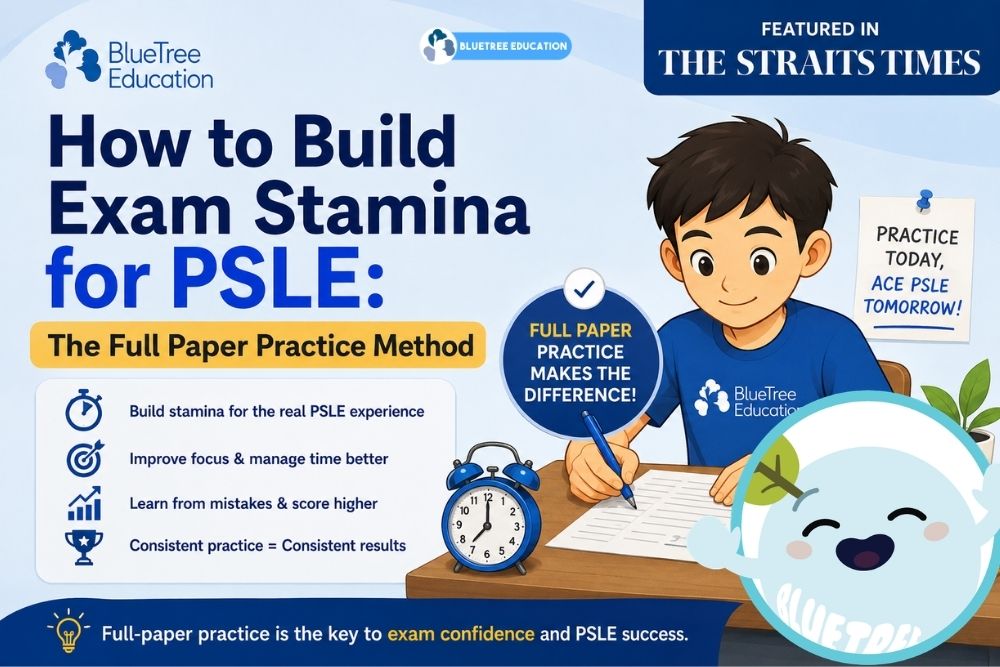
6. Condition Your Child for Exam Conditions

Practising under exam conditions is also important. Use a timer during practice to simulate the real exam. This should serve as a guide:

  • MCQs: ~35 mins
  • Open-Ended Questions (OEQs): ~50 mins
  • Checking or completing any unfinished questions: ~20 mins

Time management is essential for completing the paper without rushing.

With consistent and thoughtful practice, your child can approach the exams with greater confidence and clarity.

Recommended Learning Resources

These are some of the learning resources to aid in your child’s learning:
– PSLE past year papers
– Top School Science Prelim papers
– Science Flashcards
– Revision Guide
– Learning Video resources

At Bluetree Education, we provide free learning videos, curated flashcards and comprehensive Science guides which are fully MOE-Compliant.

How can parents help to support your child?

You don’t have to be an expert in Science to make a meaningful difference in your child’s learning. As a parent, here’s how you can support your child:

  • Create a study schedule

  • Provide quiet time for revision

  • Review mistakes together

  • Use checklists and trackers

Most importantly, be encouraging! A positive learning environment makes a world of difference in your child’s motivation.

It’s not about drilling more. It’s about learning smarter. With the right strategies, mindset and support, achieving AL1 in PSLE Science is absolutely achievable. All the best to you and your child in the PSLE journey!

Want to Experience the BlueTree Method?

Let your child try our exam techniques and resources in a Science trial class!

📌 Limited slots available. Contact us to find out more!

Like what you see?

Register for a trial class and see what more we can provide for your child today!

Like what you see?

Register for a trial class and see what more we can provide for your child today!

Recent Articles

Resources & Topics Overview

Post: PSLE Science Exam Format: How to Prepare Smart and Score AL1 in 2026