Why Do Children Panic at Math Problems — And How Do You Fix It?

why-kids-panic-at-math-problems

Why Does My Child Panic at Math Problems?

It’s a scene many parents recognise. Your child opens their exam paper, gets to the problem sums section, and something shifts. The pencil stops moving and their eyes glaze over. Maybe there’s a groan, or worse, tears start forming. If your child panics at math problems, you’re not alone, and more importantly, it’s not something they simply have to live with.

In this post, we break down exactly why children panic when they see problem sums, what’s really going on in their heads, and what you can do about it.

Table of Contents

6 Reasons For The Panic

Before we talk solutions, it helps to understand the root causes. Maths panic doesn’t come out of nowhere. It builds from a combination of academic, emotional and experiential factors.

1. Questions Are Getting Longer and Harder

Problem sums in Primary 5 and 6 are significantly more complex than what children encounter in their earlier years. Questions are longer, require more steps and use tricky phrasing that children need to decode before they can even begin solving.

For example, a statement like “Lynn’s weight is half of Bobby’s weight” seems simple, but children need to correctly assign units to each person, understand the relationship between the two values, and represent that visually or algebraically. One misreading and the entire working unravels.

When children encounter this kind of complexity without the tools to handle it, panic is a natural response.

2. They Can’t Organise the Clues

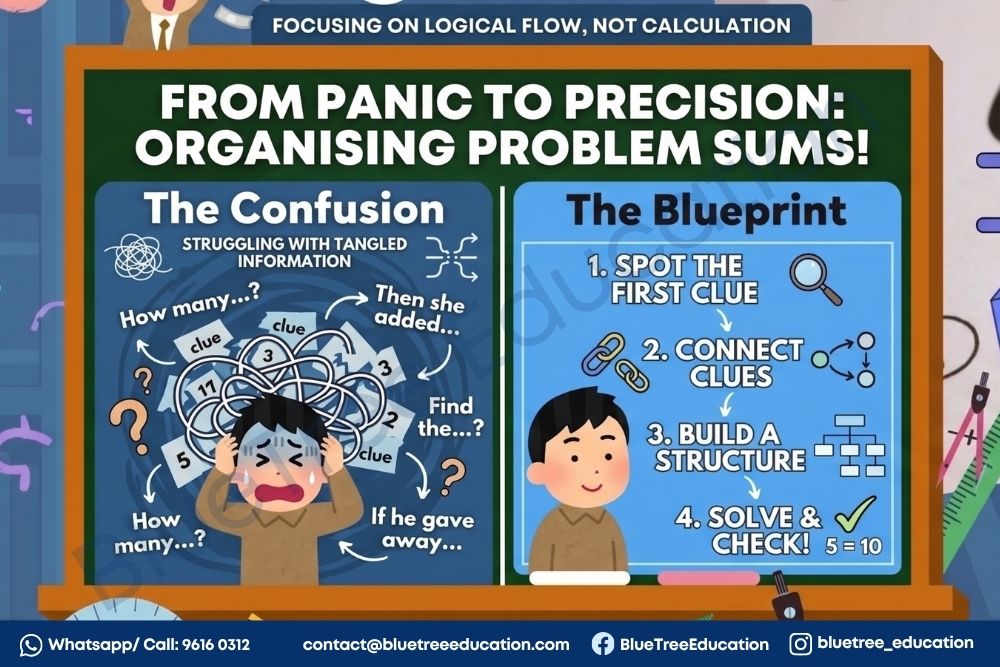
Many children who panic at math problems aren’t struggling with calculation — they’re struggling with organisation and logical flow. Problem sums contain multiple pieces of information, and children need to figure out which clue comes first, how the clues relate to each other, and what structure to use to solve the problem.

child-confused-at-problem-sums

This requires systematic processing, analytical thinking, and logical sequencing — skills that need to be explicitly taught, not assumed.

3. They Lose Track of Their Own Working

A surprisingly common issue: children write down calculations mid-way through a problem, then look back and have no idea why they wrote what they wrote. “Why did I do 90 divided by 6?” Without labels on their working, they lose the thread entirely and panic sets in.

The fix is simple but often overlooked: always label your working. Note what each number represents (e.g., “1 unit = 90 ÷ 6”) so that past-you is helping future-you, not confusing them.

4. Lack of Exposure to Different Question Types

A child who has never seen a particular type of question before will almost always panic when they see it in an exam. This is completely understandable, but preventable!

When children practise widely across all concept types, what once looked like a frightening new question reveals itself as a familiar problem in a slightly different costume. The numbers might change; the structure doesn’t. Familiarity is one of the most powerful antidotes to panic.

In Singapore’s PSLE Maths syllabus, there are approximately 20 different concept types that students need to know. Exposing children to multiple practice questions for each concept and revisiting them over time builds the recognition they need to stay calm under exam pressure.

5. Real-World Experience Gaps

Some problem sums trip children up not because of a maths gap, but a real-world experience gap. Questions about GST, discounts, or cutting ribbon often confuse children who haven’t encountered these situations in daily life.

A classic example: 

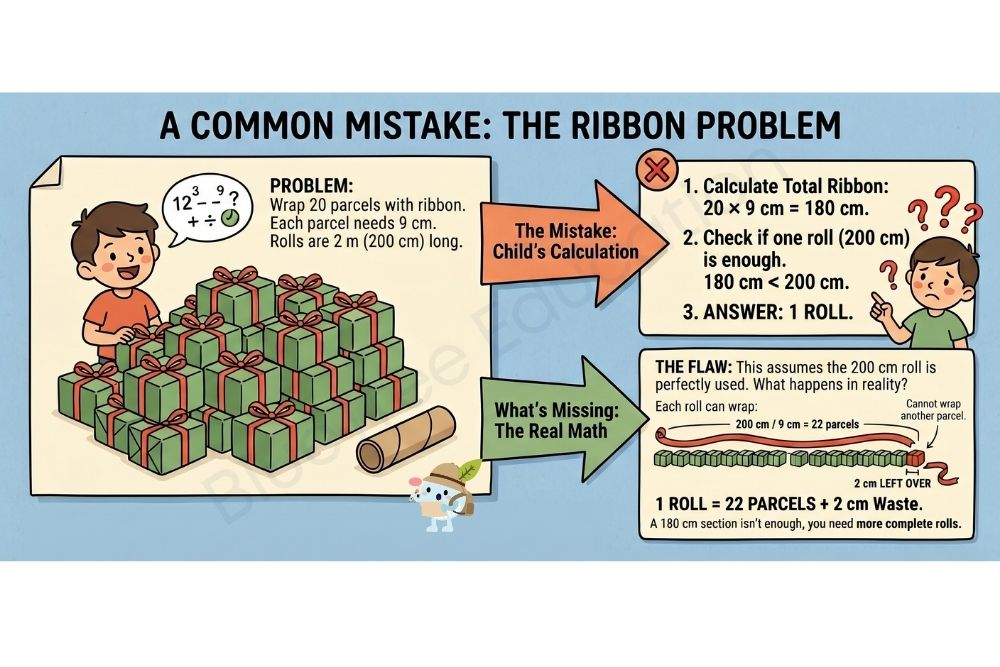
a question asks how many rolls of ribbon (each 2 m long) you need to wrap 20 parcels, where each parcel uses 9 cm of ribbon. Many children simply calculate 20 × 9 cm = 180 cm, then divide by 200 cm per roll — arriving at a wrong answer of 1 roll. 

the-ribbon-problem-common-mistake

The correct approach recognises that after cutting two 9 cm pieces, the remaining 2 cm per roll is too short to use. You actually need 10 rolls.

That insight comes from having wrapped a present before. When children lack those real-world touchpoints, abstract problem sums become genuinely confusing.

6. The Fear of Being Wrong

Perhaps the deepest root of maths panic isn’t academic, but emotional. When children face a question they can’t solve, their minds don’t just register “I don’t know this.” Instead, they spiral: What if I get scolded? What if my friend can do it and I can’t? Does this mean I’m bad at studying?

This negative feedback loop turns a tricky question into a threat. And once fear sets in, even questions the child can solve become harder, because their confidence has already been shaken.

Some children have even internalised beliefs like “I’m stupid” or “I’m just bad at maths”, all heartbreaking statements to hear, especially when the child is absolutely capable with the right support.

child-struggling-with-problem-sums

How Can My Child Overcome Maths Panic?

1. Use the T.C.M. Framework

Before attempting any problem sum, train your child to ask three questions:

bluetree-tcm-topic-concept-method

T — Topic: What topic is this question testing? (Fractions? Ratio? Percentage?)

C — Concept: What specific concept is at play? (Total unchanged? One side unchanged?)

M — Method: What method should I use to solve it? (Model drawing? Ratio? Table method?)

This simple framework stops the panic spiral before it starts. Instead of staring at a question feeling lost, the child has a structured starting point.

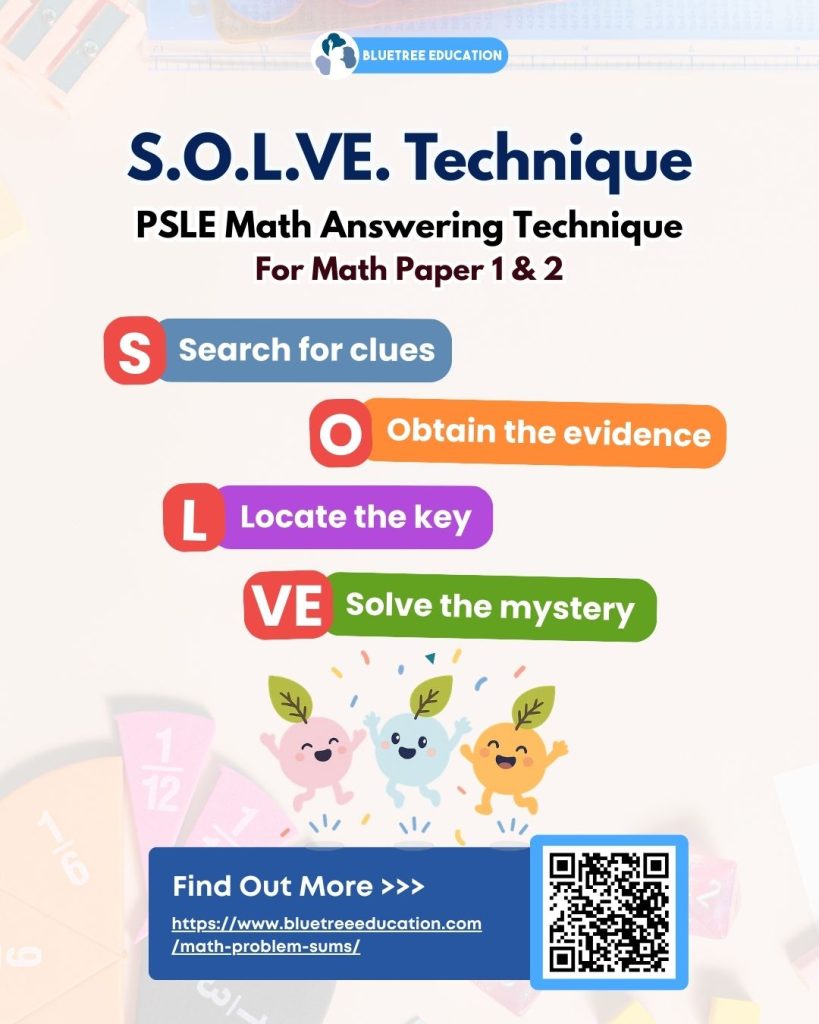
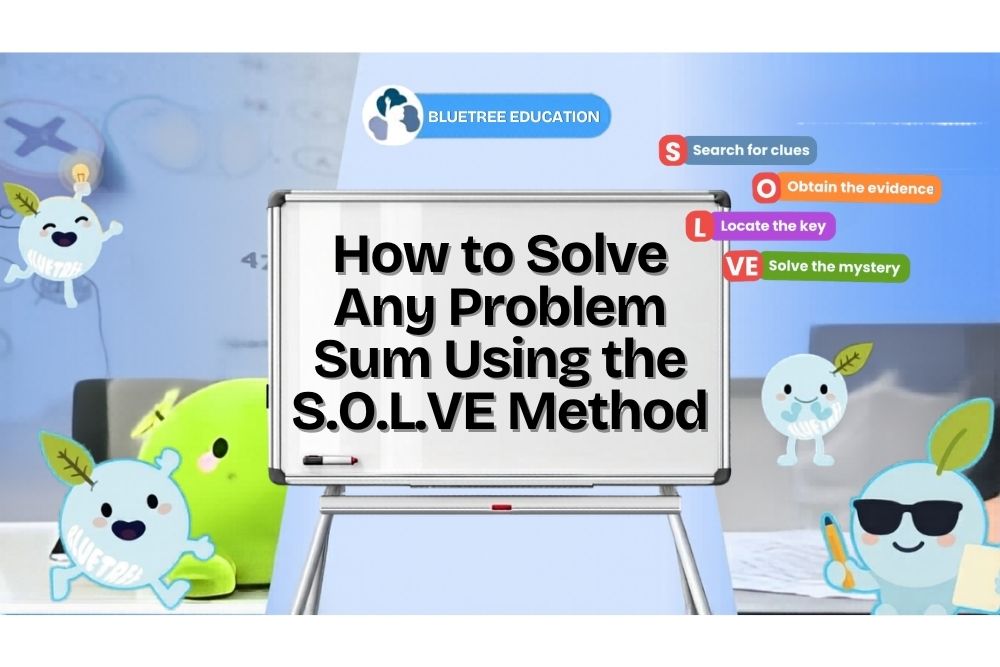
2. Follow the S.O.L.VE. Technique

S — Search for clues: Read the question carefully. Identify what each number represents. Who has more?

O — Obtain the evidence: Draw a model or diagram.

L — Locate the key: Identify the critical piece of information needed to unlock the answer

VE — solVE the mystery: Re-read the question before writing the final answer. 

SOLVE Technique

This four-step process turns an overwhelming problem into a series of manageable decisions.

3. Reframe the Question as a Story

One practical mindset shift that works particularly well for younger children: treat the problem sum like a story. Who are the characters? What are they doing? Why does Stacy need 5 kg of chicken and 10 kg of fish?

Making the question feel human and relatable lowers the emotional stakes. It transforms terrifying 5-mark problems into “a story about someone I can help.” Children will then find it easier to take the first step, which is often the hardest part.

What Can I Do For My Child?

1. Celebrate Small Wins

Progress in maths isn’t always linear. A child who used to freeze at problem sums and can now draw the correct model has made genuine progress even if they don’t get the final answer. That deserves acknowledgement.

kids-in-math-class

Positive reinforcement isn’t just feel-good encouragement. It actively rewires the emotional association children have with problem sums, replacing fear with the belief that effort leads to improvement.

2. Timed practice at home

Sitting children down with a past-year paper, timing them, and simulating real exam conditions builds exam stamina (the mental endurance to stay focused for the full duration of a paper).

This also improves time management. Children who practise under timed conditions learn which questions to move through quickly and which deserve more time. This pacing reduces anxiety on harder questions later.

Past-year papers and school papers are excellent resources. What can look like a brand new question is almost always a familiar concept with slightly different numbers. The more exposure children have, the less likely they are to be thrown by surface-level variation.

student-doing-test

Final Note

Children who panic at math problems aren’t incapable, just under-equipped and under-encouraged. The good news is that maths anxiety is not a fixed trait.

With the right frameworks, enough exposure to varied questions, and consistent positive reinforcement, children can and do change their relationship with problem sums.

Watch The Full Explaination Here

Ready to Help Your Child Tackle Problem Sums with Confidence?

At Blue Tree, our teachers are trained to meet every child where they are, rebuild their confidence, and equip them with proven techniques like T.C.M. and S.O.L.VE. so that no problem sum feels impossible.

Book a trial class today and take that first step. 💙 

Want Your Child to Excel Their Next Test?

Come join our Trial Class to see the difference a structured approach makes.

Like what you see?

Register for a trial class and see what more we can provide for your child today!

Like what you see?

Register for a trial class and see what more we can provide for your child today!

Recent Articles

Resources & Topics Overview

Post: Why Do Children Panic at Math Problems — And How Do You Fix It?