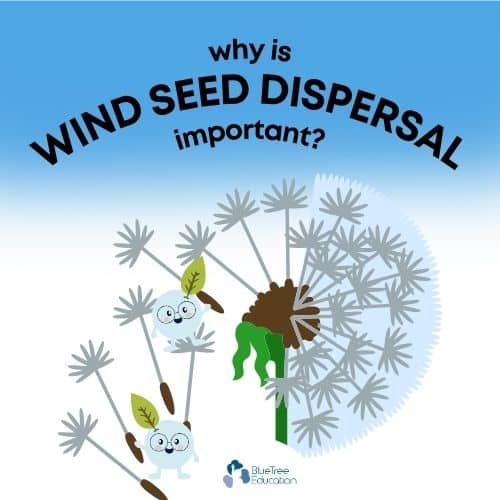
Have you ever wondered how plants grow in places far from the parent tree? One of the ways plants spread their seeds is through wind dispersal! This fascinating process allows seeds to travel great distances, ensuring the survival and growth of new plants.
What we'll be sharing in this article [Hide]
What is Wind Seed Dispersal?
Wind seed dispersal is when plants use the wind to carry their seeds away from the parent plant. This method helps reduce overcrowding, which reduces competition for water, light, space, mineral salts and nutrients with the parent plants, giving the seedlings a better chance to grow.
Seeds dispersed by wind often have special structures that allow them to be carried easily by the air.
Features of Wind-Dispersed Seeds
Seeds that rely on wind dispersal usually have unique characteristics that help them travel through the air. This is also known as structural adaptation. These include:
- Wing-like structures: Some seeds have extensions that look like wings, allowing them to glide through the air. This increases the exposed surface area to air, increasing air resistance and they can glide further distances!


More Examples of Wind-Dispersed Seeds
Here are some more common plants that use wind dispersal:
Why is Wind Dispersal Important?
Wind dispersal plays a key role in plant survival and biodiversity. It helps plants:
- Grow in new areas where they have a better chance of survival.
- Reduce overcrowding near the parent plant.
- Reduce competition for water, light, space and mineral salts/ nutrients.
- Ensure the species continues to thrive in different environments.
What are the advantages of wind dispersal?
- Spreads seeds over large areas.
- No reliance on animals or water.
- Reduces competition with parent plants.
What are the disadvantages of wind dispersal?
- Unpredictable (depends on wind conditions).
- Many seeds land in unsuitable places.
- Large numbers of seeds are needed for success.
What is the difference between seed dispersal and pollination?
Let’s start with the definitions:
Students tend to confuse between the two processes as they both involve the movement of a small seed/ pollen by wind!
These special structures are adaptations to increase the chances of pollination.
Wind seed dispersal however, does not involve the pollen grains. They are vastly different in both purpose and what is involved. Seed dispersal increases the chances of the young plants surviving, due to lesser competition for water, light, space and mineral salts with the parent plants.
Seeds are the product of fertilisation. This is where the male reproductive cells in the pollen grains fuse with the female reproductive cell in the ovule. The ovule then develops into a seed, ready for dispersal.
- Pollen grains contain the male reproductive cell carrying the male plant’s DNA.
- A seed is a fertilized plant ovule that contains an embryo. Seeds are the reproductive units of flowering plants.
Most importantly, you cannot have seeds without pollination first occurring, followed by fertilisation!
Fun Activity: Observe Wind Dispersal!
Next time you see a dandelion, try blowing on its seeds and watch how they float away. You can also collect different types of seeds and observe their shapes. Which ones do you think are dispersed by the wind?
Here’s a DIY fun Science Experiment to simulate Wind Dispersal!
- Cut out a small rectangular piece of paper.
- Cut the top of the rectangular paper in half.
- Fold the top two parts in opposite directions.
- Place a paperclip at the bottom.
- Drop the seed from a height and watch it twirl!
Experiment idea: You can modify the seed shape to see how different shapes or even mass affects dispersal distance.
Nature has many ways of spreading life, and wind dispersal is just one of them. The next time you see seeds flying in the breeze, you’ll know they are on a journey to find a new home!
🌬️ Discover Wind Dispersal in Action!🌿
Did you know that wind is one of nature’s powerful forces for seed dispersal? 🌱 Understanding how plants use wind to spread their seeds can help your child grasp important concepts in PSLE Science.
💡 Want your child to master this topic and more?
Don’t wait till the last minute! Join our Science Trial Class and give them the edge they need to ace their exams.
✅ Hands-on experiments & interactivelessons
✅ Proven exam strategies
✅ Master key topics like wind dispersal!
📅 Sign up now to reserve your spot! Let’s turn Science struggles into success! 🌟